
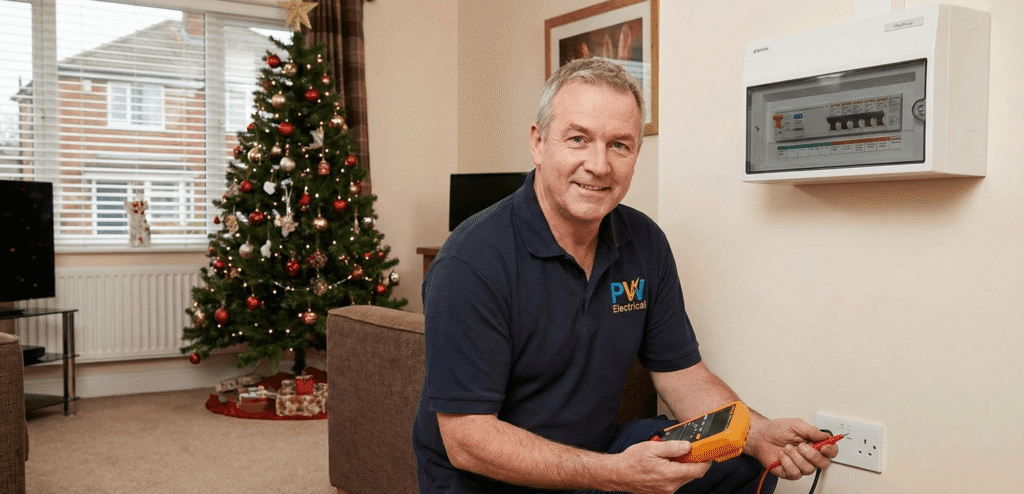
Happy New Year to all our customers in Wigan and Chorley!
As we welcome 2026, many of us are making resolutions—whether it’s joining a gym or finally sorting out the garden. But while you’re planning your year, there is one resolution that often gets overlooked: the safety of your home.
At PW Electrical, January is often one of our busiest months for calls. After the heavy electrical load of Christmas—with extra lights, heaters, and new gadgets plugged in—older electrical systems can sometimes show signs of strain. You don’t need to be a qualified electrician to spot the early warning signs. To help you start 2026 safely, I’ve put together a simple 5-Point Visual Health Check that you can do this weekend. It takes less than 10 minutes and could save you a lot of trouble down the line.
1. The “Cracked Socket” Sweep
Take a walk around your home, checking every socket and light switch. We often ignore cracked faceplates, especially if they are hidden behind the sofa or in a spare room.
- What to look for: Cracks across the plastic front, chips on the corners, or signs of discolouration (browning or yellowing) around the pin holes.
- The Risk: A crack compromises the insulating barrier, potentially exposing live parts. Discolouration is a tell-tale sign of overheating inside the socket, which is a major fire risk.
- The Fix: Don’t just tape it up. If you find a damaged accessory, replace it immediately.
2. The Flicker Test
We all have that one light in the hallway or landing that flickers occasionally. It’s easy to ignore, but you shouldn’t.
- What to look for: Change the bulb first. If the flickering continues with a fresh bulb, you likely have a loose connection in the ceiling rose or switch.
- The Risk: A loose connection causes “arcing” (electricity jumping the gap). This generates intense heat and can melt the cabling insulation over time.
- The Fix: If a new bulb doesn’t solve it, call us. This isn’t a ghost in the machine; it’s a potential fire hazard.
3. The RCD “T” Button Test
Go to your consumer unit (often called a fuse box)—usually found under the stairs, in the garage, or near the front door. If you have a modern board, you will see buttons marked with a ‘T’ or ‘Test’.
- What to do: Press the button. The switch should instantly flip to the ‘OFF’ position. (Don’t worry, you can flip it back on immediately.)
- The Risk: This device (the Residual Current Device) is designed to cut the power in milliseconds if it detects an earth fault—potentially saving you or a family member from a fatal electric shock. If the button doesn’t trip the switch, the device is faulty.
- Regulation Note: Under BS 7671 (18th Edition), we recommend you test this physically every 6 months. Start your year right by doing it now.
4. The Post-Christmas Extension Lead Check
Now that the decorations are down, check how your new gadgets are plugged in. We often see homes in Coppull and Standish with “daisy-chained” extension leads (plugging one extension lead into another) to power new computers or gaming consoles.
- The Risk: Extension leads have a maximum load (usually 13 amps). Daisy-chaining them increases resistance and the risk of overheating.
- The Fix: Plug high-power appliances (like heaters, kettles, or irons) directly into wall sockets. If you don’t have enough sockets, it’s safer and neater to have us install extra double sockets than to rely on temporary leads.
5. The “Fishy Smell” (It’s Not Dinner)
This is one of the most common calls we receive.
- What to look for: A persistent smell of fish or urine that seems to come from nowhere and lingers in a specific room.
- The Meaning: This specific smell is caused by the burning of Bakelite (the plastic used in older electrical fittings). If you smell this, electrical components are actively overheating and melting somewhere in your home.
- The Fix: Turn off the power to that circuit at the consumer unit immediately and call an emergency electrician.
Safety First for 2026
If you spotted any of these issues during your check, please don’t attempt to fix them yourself. Electricity is dangerous, and “having a go” can often invalidate your home insurance or cause injury.
Let’s keep Wigan safe this year. If you need a socket replaced, or if that RCD button didn’t trip, give our local team a call. We are happy to offer advice or pop round to investigate. Need a professional opinion? Call PW Electrical on 01257 402 004 or contact us online at pwelec.co.uk.
